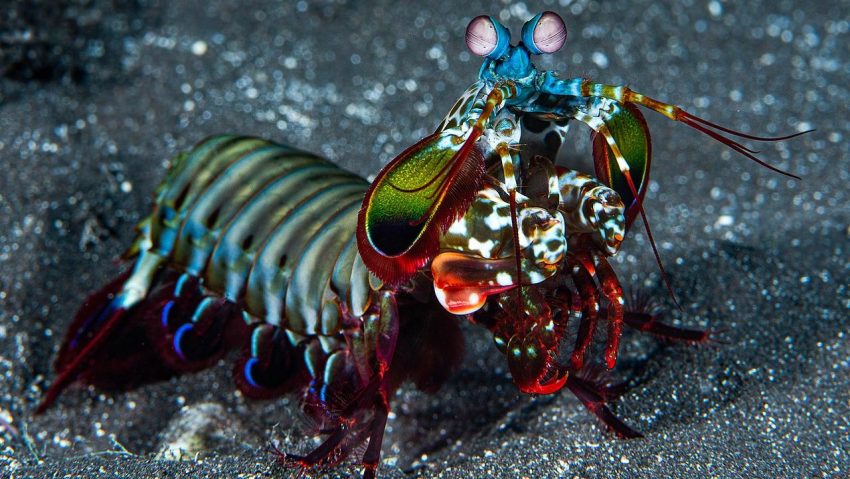
planet-marine.com – It looks like a creature from a sci-fi film—bright colors, eyes that move independently, and claws that hit harder than logic should allow. The mantis shrimp, or scientifically Stomatopoda, has earned a reputation as one of the ocean’s most extraordinary predators. Known for its explosive strikes and uncanny vision, this crustacean is a reminder that small things can completely outclass the laws of physics.
What is a mantis shrimp?
A mantis shrimp isn’t actually a shrimp. It’s part of the order Stomatopoda, distinct from true shrimp (Decapoda). Found mostly in tropical and subtropical waters, these animals are solitary hunters that live in burrows or crevices on the seafloor. Their bodies are elongated, with vivid colors that can include blues, greens, oranges, and reds—making them some of the most visually striking crustaceans in the ocean.
Unlike most shrimp, mantis shrimp have specialized raptorial appendages—front limbs designed not for swimming or walking, but for striking. That’s where their reputation begins.
The Stomatopoda: Evolution’s High-Speed Experiment
The scientific name Stomatopoda refers to the entire order that includes over 400 known species of mantis shrimp. Collectively, these Stomatopoda Stomatopods show remarkable specialization for vision, speed, and impact.
They come in two main groups:
-
Spearers – with sharp, barbed claws used to stab soft-bodied prey such as fish.
-
Smashers – with club-like appendages used to crush hard shells like snails, crabs, and clams.
Each strategy evolved for different diets, but both rely on some of the fastest and most powerful limb movements ever recorded in the animal kingdom.
The Mantis Shrimp’s Punch: Faster Than a Bullet
The mantis shrimp’s punch is the stuff of marine legend. When a smasher attacks, its club-like limb accelerates at speeds reaching 80 km/h (50 mph) underwater, delivering an impact comparable to a .22 caliber bullet—except underwater, with drag. The force is so intense that it can shatter aquarium glass if the shrimp feels threatened.
How is that even possible? The secret lies in a biological mechanism called a “spring-and-latch” system.
The mantis shrimp’s muscles store energy in a structure within the limb, then release it in a single burst. It’s like a biological crossbow: slow to draw, instantaneous to fire.
The strike is so fast it creates cavitation bubbles—tiny pockets of vapor that collapse with additional force and even produce flashes of light and heat. That means the mantis shrimp effectively punches twice: once with its club, and again with the shockwave.
Slipper Shrimp: A Different Kind of Crustacean
The slipper shrimp sometimes gets mistaken for the mantis shrimp due to its name, but it belongs to a completely different group. Slipper shrimp are flat-bodied crustaceans (family Scyllaridae) that live near coral reefs and sandy bottoms. They don’t punch or spear—they scavenge. Think of them as the quiet neighbors compared to the mantis shrimp’s loud, destructive roommate.
Their nickname comes from their shape: broad, flattened antennae that resemble slippers or paddles. While the slipper shrimp doesn’t boast superpowers, it plays an important role in the marine ecosystem by cleaning up debris and organic matter.
Eyes That Outsee the Rest of Nature
The mantis shrimp’s eyes deserve their own study. Each eye has trinocular vision, meaning it can gauge depth using just one eye. They can detect polarized light and even see parts of the ultraviolet spectrum—far beyond human capacity.
Where humans have three color receptors (red, green, blue), mantis shrimp have up to 16. This might help them navigate complex reef lighting or communicate through color patterns invisible to most predators and prey. To them, the reef is likely more vivid and information-rich than we can imagine.
Why Mantis Shrimp Fascinate Scientists
Beyond curiosity, studying the Stomatopoda gives scientists clues for:
-
Materials science: their club structure inspires stronger ceramics and armor design.
-
Robotics: the latch mechanism has influenced spring-loaded robotic limbs.
-
Vision research: their eye filters inspire optical sensors that detect polarization.
This crustacean, no longer than a human hand, continues to influence technology far beyond the ocean floor.
One Perspective Most People Miss
When people talk about the mantis shrimp’s power, they usually focus on violence. But the real marvel is control. It doesn’t strike randomly—it calculates. It adjusts aim, angle, and timing within milliseconds. Its “punch” is not rage; it’s precision.
In a way, the mantis shrimp is a perfect metaphor for expertise: build tension patiently, release energy only when the moment demands it.
A Lighthearted Parallel: Card Games and Quick Reflexes
On land, our “battles” are more playful—like fast reaction games at the table. Some card enthusiasts joke about titles like the mantis card game, a tongue-in-cheek nod to quick reflexes and timing. Unlike the shrimp, though, these games require strategy, not impact. Still, both celebrate speed—the shrimp in muscle, the players in wit.
The mantis shrimp stands as proof that evolution loves extremes. Within a few inches of shell and muscle, nature engineered both destructive force and delicate vision—two things rarely seen together. Whether you call it the peacock mantis shrimp, stomatopod, or underwater boxer, it’s more than a curiosity. It’s a reminder that mastery, in any form, comes from balance: power in precision, speed in patience, and beauty in purpose.